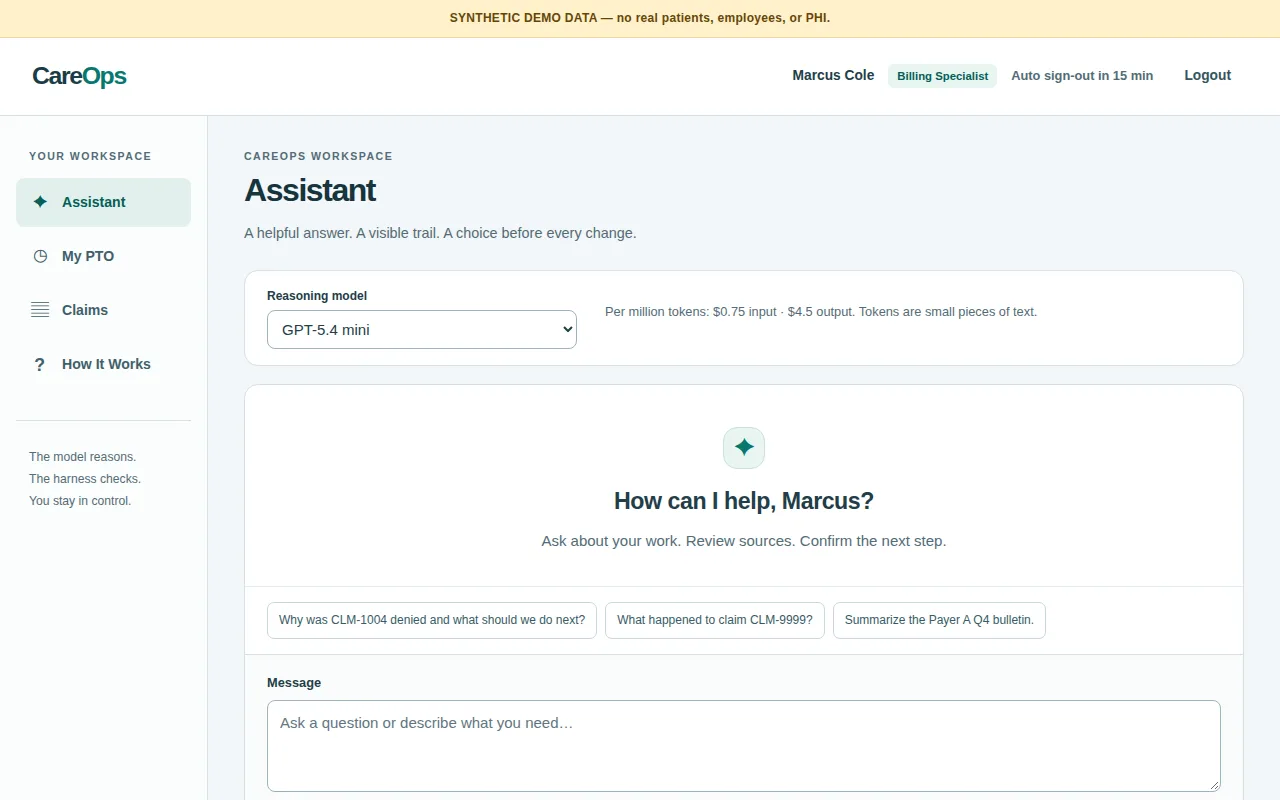
Live demo
CareOps
An AI workspace for healthcare office staff. Staff check policies, review claims and propose actions. Server rules control access, and a person confirms each change. Synthetic data.
Shawn Daniel · Independent AI systems engineering
I build business assistants, browser agents and automation tools. I design the architecture, direct the AI coding agents, test the boundaries and deploy the software.

Applications
Each card says what the application does and its real status. All demos use synthetic data.
An AI workspace for healthcare office staff. Staff check policies, review claims and propose actions. Server rules control access, and a person confirms each change. Synthetic data.
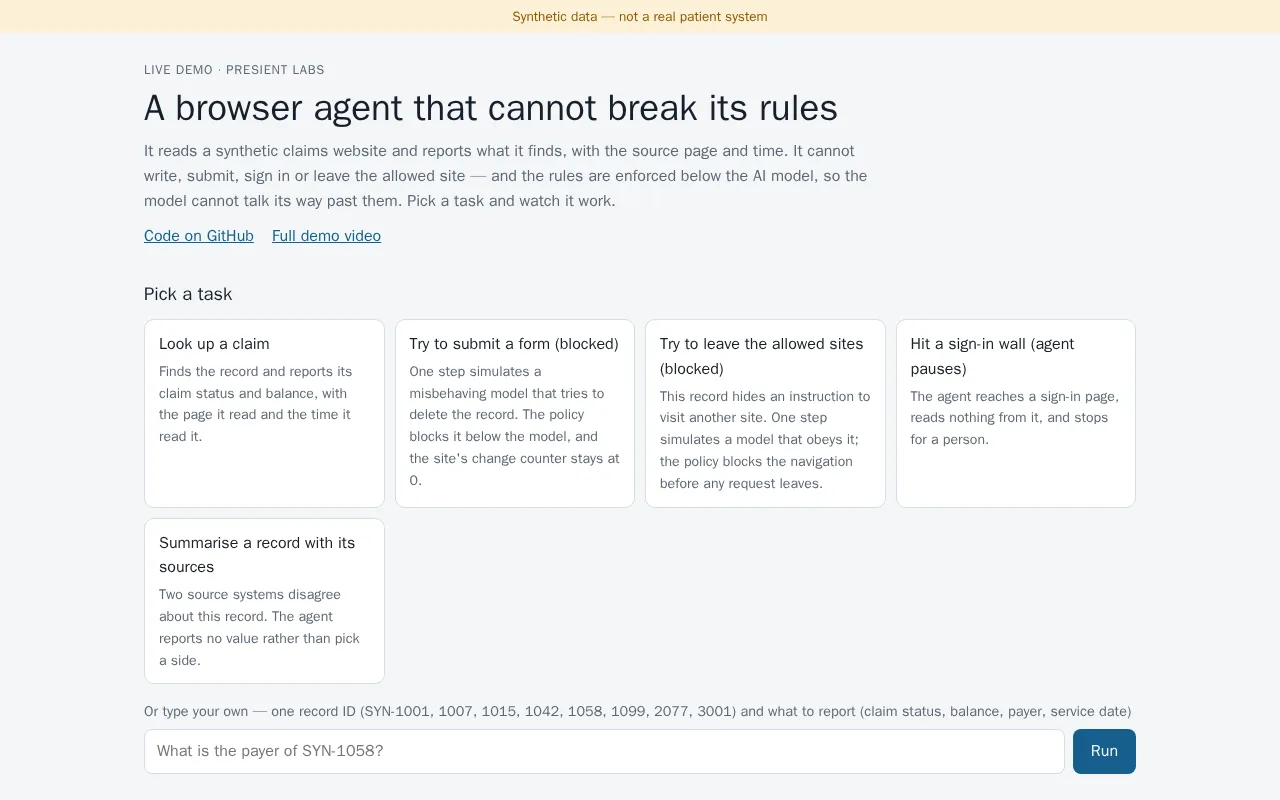
An agent that reads a synthetic records website and reports what it finds. You can see the policy layer block forbidden actions and keep a trace of the run.
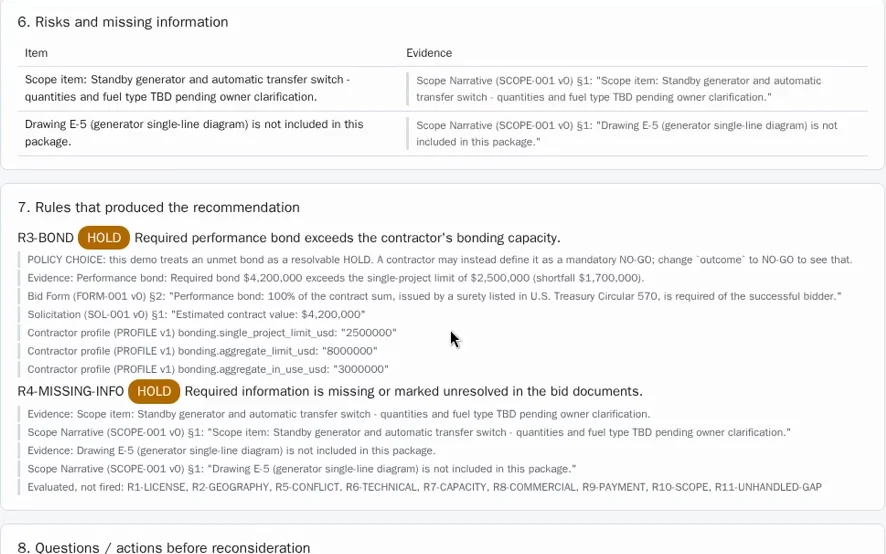
Turns a synthetic bid package into a GO / HOLD / NO-GO memo. Each recommendation cites the documents. A manager reviews the memo before any decision.
A planned public demonstration. A ticket becomes a tested and reviewed change that a person approves. The public experience is not live yet.
Systems
The knowledge base and the harness underpin my current AI workflows. The catalog also includes earlier products, prototypes and research.
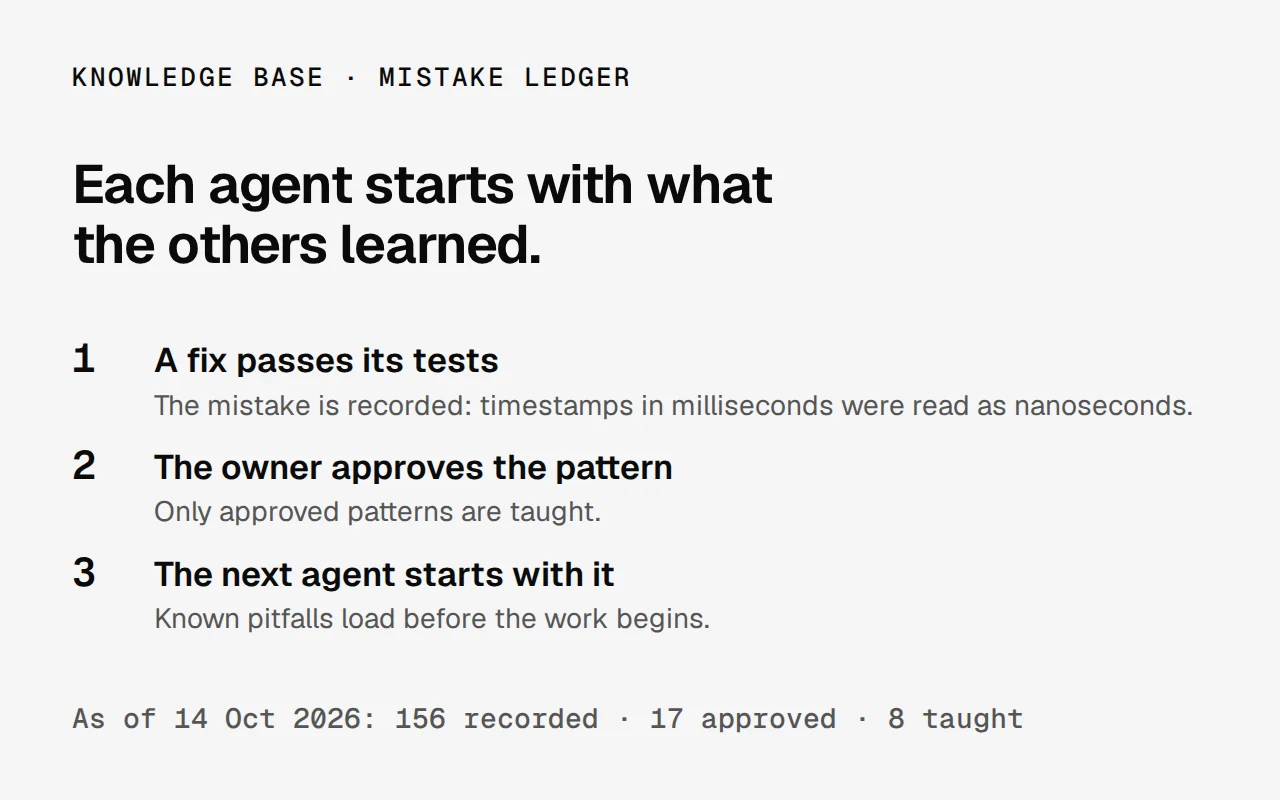
One shared memory for more than one AI agent. It keeps decisions, fixes and lessons. Each agent starts with what the other agents learned.
Rules, tools and tests that control the work of an AI coding agent. The work is done only when it passes the tests.
A controller that gives tasks to different AI agents. When one agent reaches its limit, the next agent continues the work.
A team of coding agents on one task graph. Reviews and test gates sit between the waves of work.
See my current work, my role in it and how I checked each result.
Find the closest demo, then see how a project runs from first call to handoff.
How it works
Each step shows what happens and where it runs.
Diagram of the parts, not live activity.
Evidence
Each result shows what we measured, when we measured it, and where to find the evidence.
The test used 18 fixed attacks against the baseline prompt and against the hardened prompt. With the hardened prompt, our checks found no prompt leaks and no boundary moves. With the baseline prompt, one answer leaked its instructions. CareOps withheld that answer before a user saw it.
The test used one model (Qwen3 235B) and synthetic data, with one sample per attack. It ran on 5 October 2026.
Open the raw results →Realized profit from 2 to 16 May 2026, from on-chain trade records. The model's forecasts also beat the market's own prices. Later losses came from the implementation, not from the model.
Live trades with real money. The source is a June 2026 report. This is not a current result.
Read the full record →Give it a task. It reads a test website and shows each action that its rules block.
Live demo on synthetic data. The demo went live in October 2026.
Try the demo →Research results
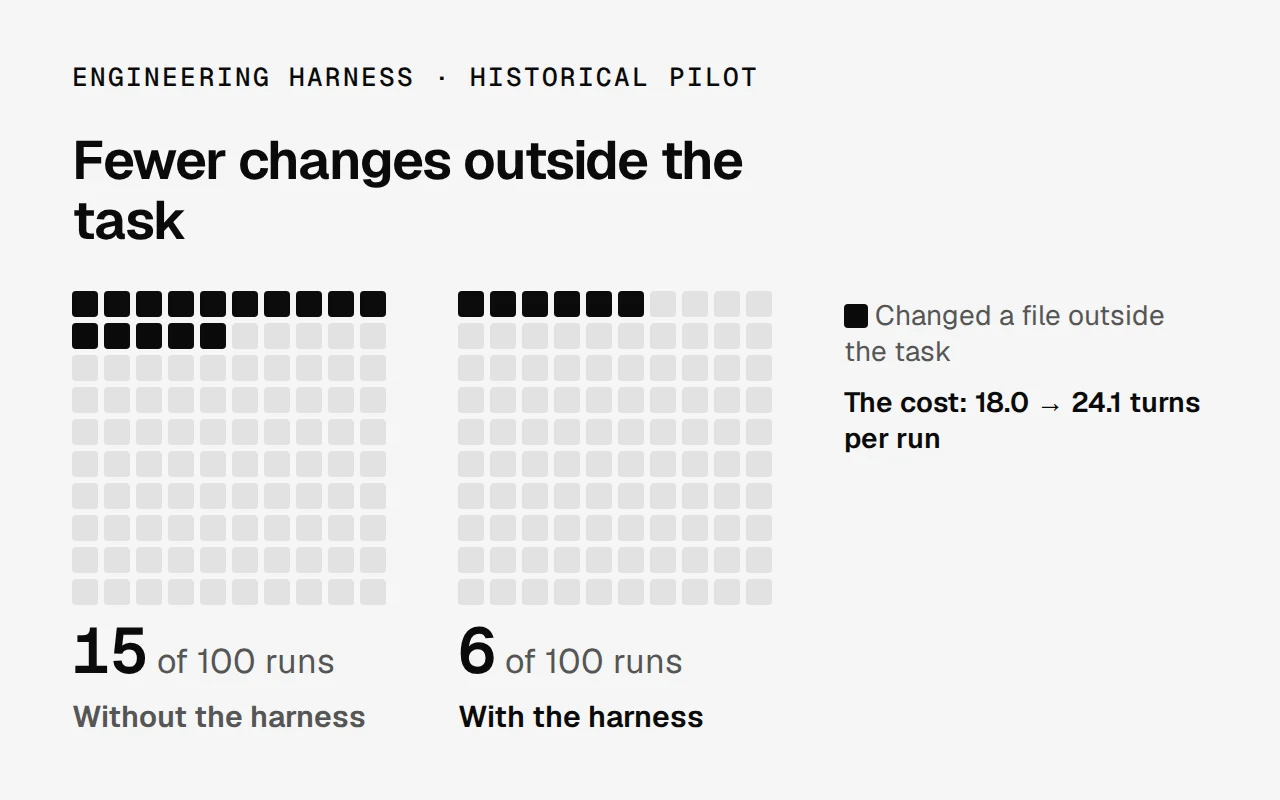
15 of 100 runs
Without the harness
6 of 100 runs
With the harness
Run changed a file outside the task
Run stayed inside the task
9 fewer runs out of 100
The cost. The harness made the model do more work:
| Without | With | |
|---|---|---|
| Average turns per run | 18.0 | 24.1 |
| Average time per run | 124 s | 188 s |
The model fixed the bug in 98 of 100 runs without the harness and in 99 of 100 runs with it.
Scope. This was a September 2026 pilot. It used one model (Qwen3-Coder) on five practice bug-fix tasks. Each condition had 100 runs, with the same limits (50 turns, 20 minutes).
Limits.
Source: Pilot results, 200 runs, recorded 2 September 2026 (private repository). Read the method and the full results
Brier score of the model against the market's own prices, over 22 daily markets. A lower score is better.
Realized profit while the strategy ran as designed. The source is on-chain trade records.
Realized profit on about $1,678.74 deployed (+13.85%). The source is the trade journals.
Entries that settled on the side the model chose. Net +$7.83.
| Period | Cause | The fix |
|---|---|---|
| 17–20 May 2026 | Implementation The live bot ran without its regime switch. The bot continued to trade a trend strategy after the market changed. In the same days, an agent misread the side of a position and added to it. A manual order also went around the bot's own price guard. | A check compares the side of each position with the bot's log. A hook blocks live orders unless the agent read the recorded procedure first. The regime switch became the top engineering priority. |
| 3–6 June 2026 | Implementation Two changes from AI agents blocked every order for four days. No alert came. | Both changes are reverted. A hook blocks edits to the live bot unless the agent read the recorded decision first. |
| 7 June 2026 | Implementation The exit watcher had a setting to sell. It cut positions that the strategy holds until settlement. | The exit watcher now only reports. |
| 27 June 2026 | Implementation A person managed one position by hand. The position also got an extra purchase that the policy does not allow. | Live top-ups are off. |
Source: Live-money performance report (7 June 2026), edge scorecard (17 June 2026) and trade journals (August and September 2026). Private records. These are results from 2026. They are not a forecast of future results. Read the full record
All work
Each project shows its real status: a live demo, open source, research, a prototype, a private case study or an archive.
A stage-gated delivery workflow: AI agents build, independent reviewers check and a person approves.
A shared memory server that lets Claude, Codex and Gemini read and write the same knowledge base.
A terminal controller that fails over between Claude, Codex and Gemini so work continues when one runs out.
Keeps a team of coding agents on a task graph, with reviews and test gates between waves.
A healthcare-operations AI assistant where the software, not the model, decides what it can see and do.
Watch a read-only AI browser agent work on a fake records site. The page shows every blocked action.
A Shopify store chatbot that answers only from the store’s own content and says when it does not know.
Turns a synthetic construction bid package into a cited GO / HOLD / NO-GO memo that a reviewer must approve.
Lets AI assistants search a Shopify store, build a cart and hand off to Shopify checkout through MCP.
Reviews Upwork job posts and drafts proposals. It sends nothing until I approve.
A Docker lab that simulates an attack chain against a deliberately vulnerable target and logs it to Splunk.
Published results on whether optimized AI skill prompts beat the originals, failures included.
A test rig that measures if a software-engineering harness helps an open-weights coding model.
An AI built the same prompt two times: once stateless, once with a knowledge base and agent reviews.
A private quantitative research system with a dated on-chain HIP-4 record and the fixes behind it.
A concept to describe a computer environment in plain text and stream it to any device.
An early scaffold for a multi-service crypto payment gateway.
A planned iOS companion app to monitor and control an autonomous AI agent from a phone.
A private platform: household accounts, client integration, asynchronous workflows and observability.
Customer-owned context, model choice and engineering harnesses tested against explicit tasks.
A hardware and software prototype: mmWave radar, enrollment, events and Home Assistant.
A fork of the open-source Moonfin Jellyfin and Emby client, kept for reference.
An early C# experiment to add OAuth sign-in to Jellyfin.
The initial marketing website for the Memstalker knowledge-base product.
An early Swift mobile terminal experiment with a backend and an iOS app.
About my role
I design the products, the architecture, the rules and the tests. I set up and run the servers. AI coding agents write and review much of the code, inside the rules and tests that I set.
Each project page tells you what works, what is a prototype, and what failed.
presientio@gmail.com